
Announcement
Other News
Market News
Singapore's MAS Publishes Global Layer One (GL1) Whitepaper
The Monetary Authority of Singapore has unveiled its Global Layer One framework—a shared, public-permissioned ledger for regulated institutions to issue, trade, and settle tokenised assets and digital money across borders. Designed to reduce fragmentation and improve interoperability, GL1 could reshape cross-border finance and accelerate institutional adoption of blockchain technology.
Updated Jan 17, 2026, 7:29 p.m.
Source: Monetary Authority of Singapore - Global Layer One (GL1) Whitepaper, May 2024.
The Monetary Authority of Singapore (MAS) has released its Global Layer One (GL1) whitepaper, setting out a vision for a multi-purpose, shared ledger designed for regulated financial institutions. The initiative aims to host tokenised assets and digital money across jurisdictions, applying common standards for identity, assets, and smart contracts. By enabling inherently interoperable applications for issuance, trading, settlement, and payments, GL1 seeks to reduce market fragmentation and unlock trapped liquidity.
The GL1 model adopts a public-permissioned framework, combining the openness of public networks with the governance and safeguards of regulated participation. It emphasises interoperability, common protocols, and composable applications—creating the foundation for synchronised settlement mechanisms such as delivery-versus-payment (DvP) and payment-versus-payment (PvP). If implemented at scale, GL1 could modernise legacy infrastructure, providing greater efficiency and security for cross-border transactions.
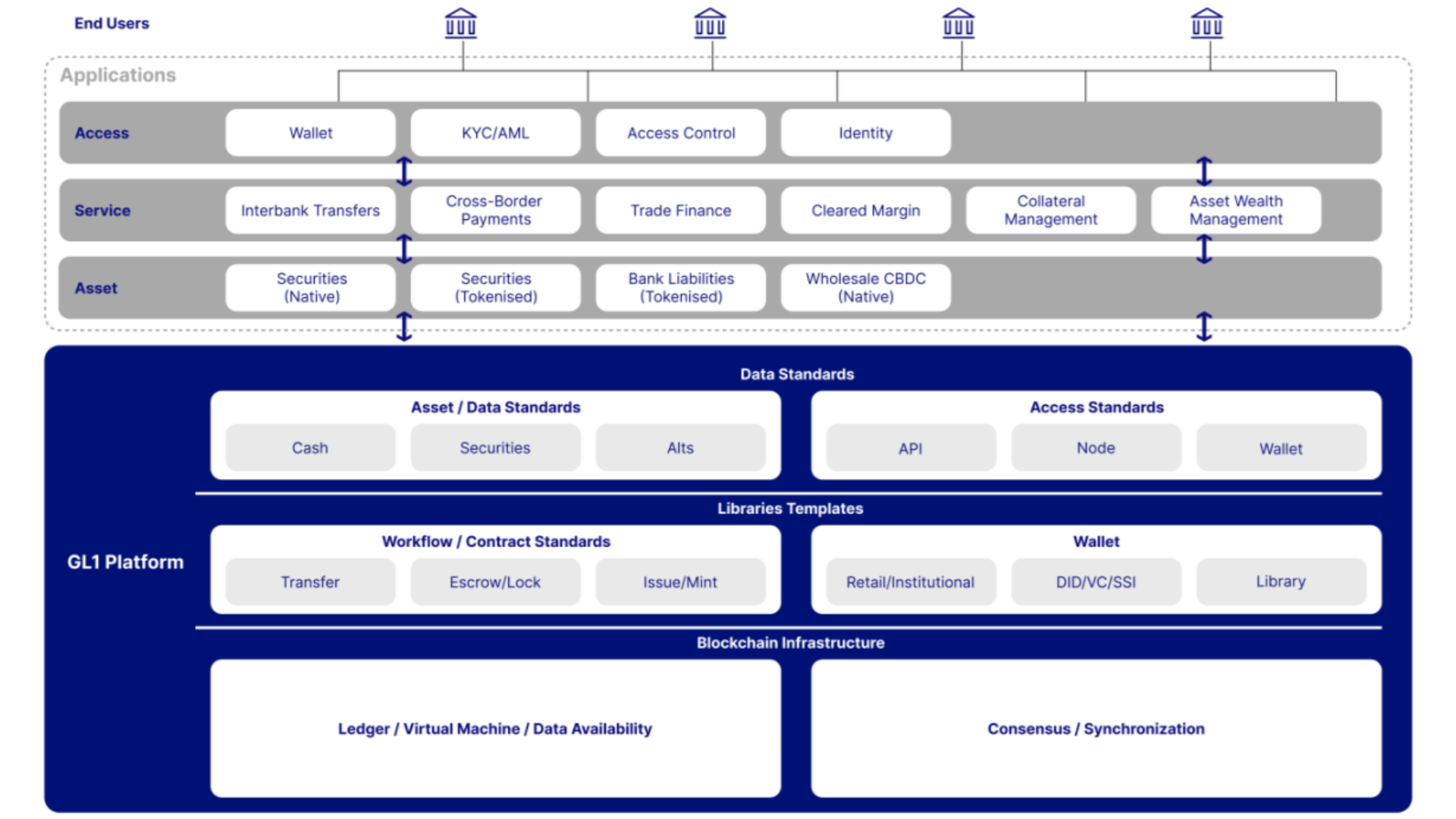
Figure 1: GL1 Architecture Overview — An illustrative model from the Monetary Authority of Singapore's Global Layer One (GL1) whitepaper, outlining the proposed shared ledger framework for regulated financial institutions.
Recent developments in the global market show similar momentum. Tokenisation of money market funds, U.S. Treasuries, and other traditional instruments is gaining traction, with large institutions like BlackRock, Goldman Sachs, and BNY Mellon piloting tokenised asset platforms. These moves point to an emerging market structure where regulated blockchain networks integrate seamlessly with existing financial systems, paving the way for broader adoption of onchain settlement.
GL1 represents a significant step toward institutional-grade blockchain adoption. By aligning regulated entities under shared technical and legal standards, it offers a blueprint for scaling tokenisation while maintaining trust and compliance. Its potential to enable faster, more transparent, and interoperable cross-border transactions marks it as a key development in the evolution of digital markets.


All metrics, including index values, reserve data, proof-of-reserve calculations, and protocol statistics, are provided for informational purposes only and are subject to change. On-chain data and reserve disclosures are based on automated reporting mechanisms and may not reflect real-time conditions.
Participation in the protocol involves risk, including but not limited to market volatility, execution risk, liquidity constraints, smart contract risk, custodial risk, and third-party dependency risk. Historical or displayed metrics are not indicative of future performance.
Users are solely responsible for assessing the suitability of the protocol for their own circumstances and should seek independent professional advice where appropriate.